

Medical exam preparation is undergoing its most significant transformation in decades. As assessment methods evolve to prioritise communication, reasoning, empathy, and real-world decision-making, traditional revision techniques are no longer enough.
Today’s clinical assessments, whether for PLAB, OSCEs, MRCP PACES, or postgraduate exams, demand a level of practical readiness that textbooks and passive learning simply cannot deliver.
Technology, however, is rapidly filling this gap. Artificial intelligence, simulated patient interactions, and immersive scenario-based learning are reshaping how clinicians prepare for modern assessments. The future of medical exam preparation is not just digital — it’s adaptive, interactive, and clinically realistic.
Why Traditional Study Methods Are No Longer Sufficient
Historically, medical exam preparation relied heavily on reading lists, lectures, memorisation, and peer practice. While these methods build theoretical knowledge, they fall short in replicating the complexity of real clinical encounters.
Modern OSCE-style exams now assess:
- Clinical communication
- Shared decision-making
- Risk recognition
- Structured reasoning
- Empathy and rapport
- Time-limited problem solving
- Professionalism and cultural awareness
These are competencies that cannot be developed through reading alone. They require performance-based learning — repeated exposure to realistic, emotionally varied, time-sensitive scenarios.
This shift explains why traditional methods leave many candidates feeling confident in theory but underprepared when facing real exam stations.
How AI Is Transforming Medical Training
Artificial intelligence is emerging as a cornerstone of next-generation clinical exam preparation. AI-powered systems can simulate patient interactions, generate exam-style scenarios, and provide personalised feedback, at a level of consistency that is difficult to achieve in peer-practice settings.
1. Adaptive Learning Paths
AI analyses a learner’s performance across multiple scenarios and automatically adjusts difficulty, complexity, and case selection.
Instead of following a generic study path, learners experience:
- Personalised station types
- Automated identification of weak areas
- Targeted performance improvement
- Dynamic question sets
This reduces wasted study time and ensures every session aligns with individual learning needs.
2. Real-Time Feedback and Communication Analysis
One of the biggest challenges in OSCE-style exams is communication.
AI systems can now:
- Analyse tone
- Track empathy statements
- Evaluate structure
- Detect missed red flags
- Identify unclear explanations
This provides an objective assessment that is difficult to achieve through self-practice alone.
3. Predictive Performance Indicators
Advanced AI can forecast overall exam readiness by analysing patterns across scenarios — helping learners identify gaps well before the exam.
These insights include:
- Which station types consistently cause difficulty
- Whether the structure is improving
- Trends in time management
- Consistency in safety-netting
Predictive analytics empower learners to adjust their approach with precision.
Simulated Patients: The New Standard of Realism
Simulated patient interactions have long been used in medical education, but digital platforms now replicate this experience with even greater accessibility and accuracy.
Why simulated patients improve learning outcomes:
- They expose learners to diverse emotional and clinical contexts
- They provide a safe environment to make mistakes
- They enable repeated practice without logistical constraints
- They offer feedback rooted in real patient experiences
For IMGs in particular, simulated patients offer a crucial opportunity to familiarise themselves with UK communication norms — including empathy, shared language, and cultural considerations.
Scenario-Based Learning: The Core of Modern Preparation
Scenario-based learning is quickly becoming the most effective method for preparing for clinical assessments. It focuses on application rather than memorisation and mirrors the exact decision-making process used in OSCE and workplace environments.
Key benefits include:
1. Enhanced Knowledge Retention
Memory improves when learning is active. Performing a scenario creates stronger cognitive pathways than reading notes.
2. Development of Clinical Instincts
Repeated exposure to patterns sharpens clinical reasoning and reduces hesitation.
3. Improved Communication Skills
Scenarios require empathy, clarity, and responsiveness — skills best learned through practice, not theory.
4. Better Stress Management
Simulated pressure prepares candidates for real exam conditions.
5. Structured Thinking
Scenario-based practice reinforces frameworks such as ICE, signposting, and safety-netting, which are essential in UK clinical assessments.
Platforms like RevisionProsCE integrate these techniques with examiner-style structure, offering realistic scenarios that help clinicians build competence and confidence simultaneously.
The Next 5 Years: What the Future Looks Like
The pace of technological innovation suggests that medical exam preparation will become increasingly immersive. Trends already gaining momentum include:
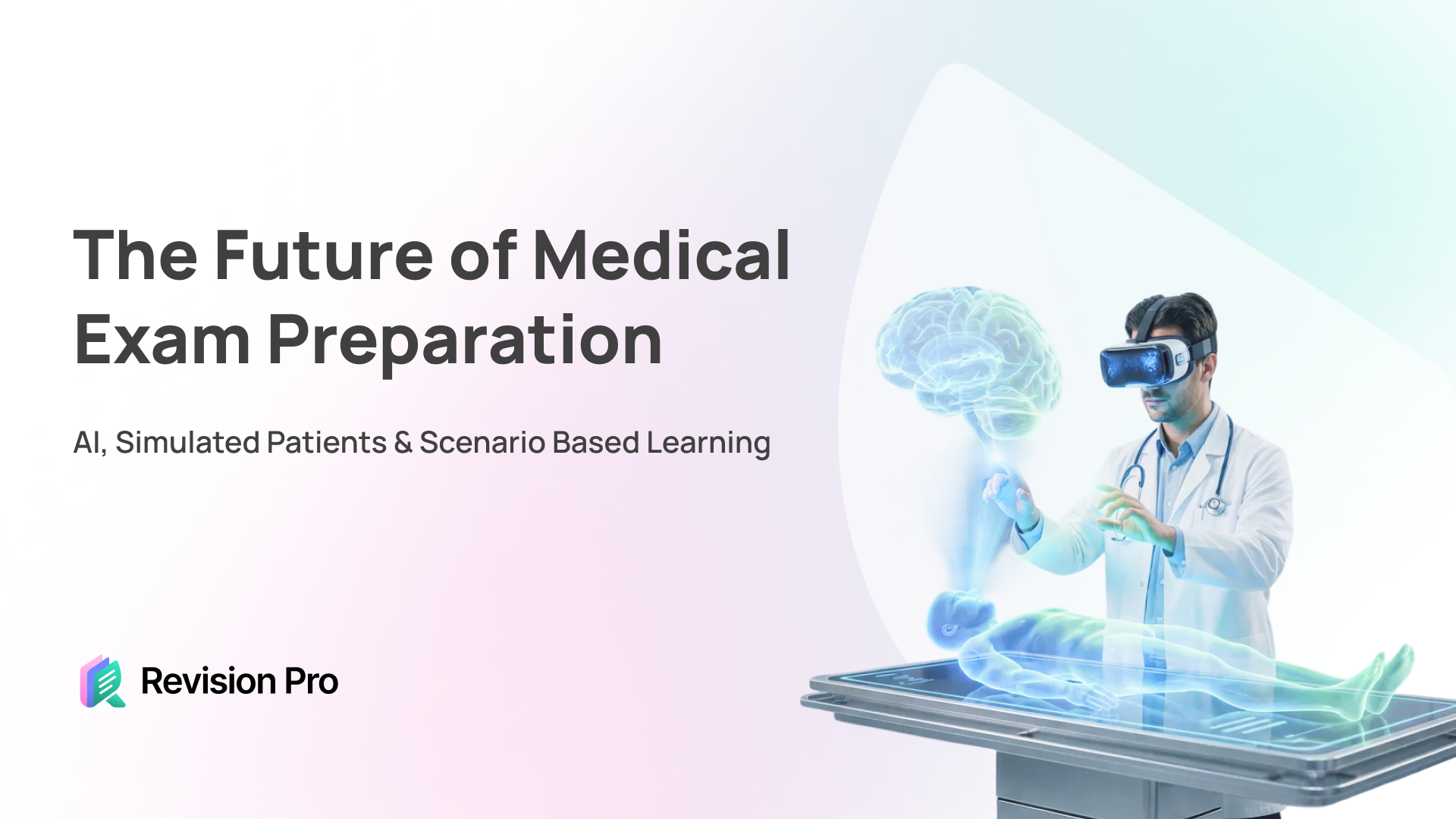
1. Virtual Reality (VR) Medical Simulations
VR will allow learners to practise examinations, clinical procedures, and emergency responses in fully immersive environments.
2. Emotionally Intelligent AI Patients
AI-driven avatars capable of responding emotionally, challenging candidates with realistic reactions such as anxiety, denial, frustration, or distress.
3. Wearable Devices for Performance Tracking
Biometric sensors may soon measure heart rate, stress levels, and communication pacing — providing deeper insights into exam readiness.
4. Fully Personalised Exam Pathways
Future platforms will design end-to-end study journeys based on a learner’s performance, career interests, and exam goals.
Next-Generation Exam Prep for Modern Medical Learners
Medical exam preparation is shifting from a passive to a performance-based approach. AI, simulated patients, and scenario-driven training are not futuristic ideas; they are already redefining the way clinicians prepare for high-stakes assessments.
These tools allow learners to practise more realistically, receive richer feedback, and engage with training environments that closely mirror real-world clinical practice. As a result, candidates who rely solely on traditional methods risk being left behind.
Platforms such as RevisionProsCE already incorporate scenario-based learning designed by UK clinicians, offering candidates the opportunity to prepare with realistic cases, structured frameworks, and personalised practice — a model increasingly aligned with the future of medical training.